


Page 3615 - index
P. 3615
3. Recommendations for iron application
Sources of iron
Among different inorganic fertilizer sources of iron, sulphate and chelated products are
commonly used. Besides, organic manures like FYM contain good amount of iron.
Accordingly, farmers can use either of the sources or mixed application of both to amend iron
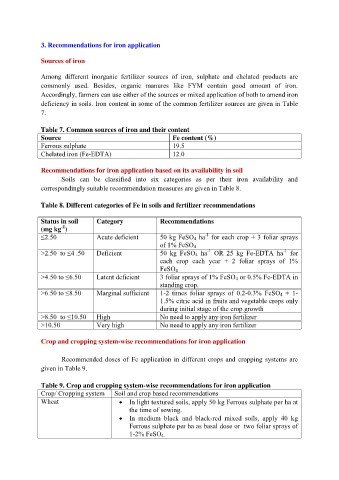
deficiency in soils. Iron content in some of the common fertilizer sources are given in Table
7.
Table 7. Common sources of iron and their content
Source Fe content (%)
Ferrous sulphate 19.5
Chelated iron (Fe-EDTA) 12.0
Recommendations for iron application based on its availability in soil
Soils can be classified into six categories as per their iron availability and
correspondingly suitable recommendation measures are given in Table 8.
Table 8. Different categories of Fe in soils and fertilizer recommendations
Status in soil Category Recommendations
-1
(mg kg )
-1
≤2.50 Acute deficient 50 kg FeSO 4 ha for each crop + 3 foliar sprays
of 1% FeSO 4
-1
-1
>2.50 to ≤4 .50 Deficient 50 kg FeSO 4 ha OR 25 kg Fe-EDTA ha for
each crop each year + 2 foliar sprays of 1%
FeSO 4
>4.50 to ≤6.50 Latent deficient 3 foliar sprays of 1% FeSO 4 or 0.5% Fe-EDTA in
standing crop.
>6.50 to ≤8.50 Marginal sufficient 1-2 times foliar sprays of 0.2-0.3% FeSO 4 + 1-
1.5% citric acid in fruits and vegetable crops only
during initial stage of the crop growth
>8.50 to ≤10.50 High No need to apply any iron fertilizer
>10.50 Very high No need to apply any iron fertilizer
Crop and cropping system-wise recommendations for iron application
Recommended doses of Fe application in different crops and cropping systems are
given in Table 9.
Table 9. Crop and cropping system-wise recommendations for iron application
Crop/ Cropping system Soil and crop based recommendations
Wheat In light textured soils, apply 50 kg Ferrous sulphate per ha at
the time of sowing.
In medium black and black-red mixed soils, apply 40 kg
Ferrous sulphate per ha as basal dose or two foliar sprays of
1-2% FeSO 4.

