


Page 3619 - index
P. 3619
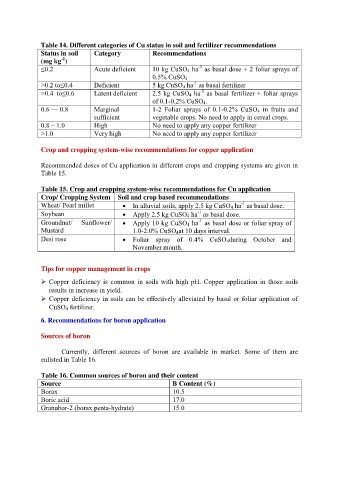
Table 14. Different categories of Cu status in soil and fertilizer recommendations
Status in soil Category Recommendations
-1
(mg kg )
-1
≤0.2 Acute deficient 10 kg CuSO 4 ha as basal dose + 2 foliar sprays of
0.5% CuSO 4
-1
>0.2 to≤0.4 Deficient 5 kg CuSO 4 ha as basal fertilizer
-1
>0.4 to≤0.6 Latent deficient 2.5 kg CuSO 4 ha as basal fertilizer + foliar sprays
of 0.1-0.2% CuSO 4.
0.6 — 0.8 Marginal 1-2 Foliar sprays of 0.1-0.2% CuSO 4 in fruits and
sufficient vegetable crops. No need to apply in cereal crops.
0.8 – 1.0 High No need to apply any copper fertilizer
>1.0 Very high No need to apply any copper fertilizer
Crop and cropping system-wise recommendations for copper application
Recommended doses of Cu application in different crops and cropping systems are given in
Table 15.
Table 15. Crop and cropping system-wise recommendations for Cu application
Crop/ Cropping System Soil and crop based recommendations
Wheat/ Pearl millet In alluvial soils, apply 2.5 kg CuSO 4 ha as basal dose.
-1
-1
Soybean Apply 2.5 kg CuSO 4 ha as basal dose.
-1
Groundnut/ Sunflower/ Apply 10 kg CuSO 4 ha as basal dose or foliar spray of
Mustard 1.0-2.0% CuSO 4at 10 days interval.
Desi rose Foliar spray of 0.4% CuSO 4during October and
November month.
Tips for copper management in crops
Copper deficiency is common in soils with high pH. Copper application in those soils
results in increase in yield.
Copper deficiency in soils can be effectively alleviated by basal or foliar application of
CuSO 4 fertilizer.
6. Recommendations for boron application
Sources of boron
Currently, different sources of boron are available in market. Some of them are
enlisted in Table 16.
Table 16. Common sources of boron and their content
Source B Content (%)
Borax 10.5
Boric acid 17.0
Granubor-2 (borax penta-hydrate) 15.0

